Do you remember those kickball games in elementary school? The same three athletic kids always won, while the rest of us mastered the art of pretending to tie our shoes.
Traditional sports often feel like trying to fit square pegs into round holes. But something amazing is happening in Southwest Florida. It’s changing the way we think about sports.
Now, 70-year-old roller hockey players skate alongside 5-year-olds. BMX tracks welcome balance bikes and pro riders. Rugby focuses on building character, not just winning.
This isn’t about giving everyone a trophy. It’s about creating places where everyone can find their “flow state.” That’s when challenge meets capability.
When we drop the narrow athletic ideals, more people join in. Fewer drop out. Who knew removing barriers could be so effective?
Adaptive & Unified Programs
Remember when adaptive sports were separate and had low expectations? We’ve moved past that. Southwest Florida is leading a revolution in sports.
Today, adaptive sports are about inclusion, not separation. Olympic hopefuls and adaptive skaters learn together. It’s like seeing Hamilton with a local theater group – everyone’s journey is valued.
The SWFL Sharks Rugby club focuses on life skills, not just winning. They aim to build people, not just athletes.
Modern programs are changing the game:
- Roller hockey leagues have no checking or off-sides for better play
- BMX tracks welcome toddlers and pros together
- Pickleball uses obstacle courses instead of ladders
- Rugby clinics offer non-contact versions that keep the sport’s essence
This isn’t about lowering standards. It’s about making sports more inclusive. The YMCA shows that removing barriers increases participation.
| Traditional Model | Modern Adaptive Approach | Impact Difference |
|---|---|---|
| Segregated facilities | Shared training spaces | Community integration |
| Lowered expectations | Adapted challenges | Maintained standards |
| Competition focus | Skill development focus | Long-term engagement |
| One-size-fits-all rules | Customized participation | Broader accessibility |
In these mixed environments, everyone learns. A future Olympian helps an adaptive athlete, teaching both about perseverance. Rugby players of all levels discover that being different doesn’t mean being less.
These programs are more than charity. They’re labs for a new sports model. By embracing inclusion, participation rates have doubled. We’re learning that the best athletes are those who change the game, not just win medals.
Community Partnerships
Community partnerships are like the stars of a hit Broadway show. They bring people together in Southwest Florida, creating a win-win situation. It’s more than just charity; it’s a beautiful example of how everyone can benefit.
Collier County’s BMX track is a great example. It’s owned by the county but run by volunteers. They work hard to keep the track in top shape, host races, and even lend out bikes. This way, no kid is left out because they can’t afford to play.
The YMCA has found a smart way to introduce pickleball to teens. They offer affordable fees, making it possible for families of all incomes to join. It’s a real-life example of making things accessible, not just talking about it.
Ice rinks in Fort Myers and Hertz Arena are doing something special. They’re not just hosting public skates. They also run programs to teach kids how to skate, preparing them for competitive adaptive skating. It’s a way to nurture talent while having fun.
Businesses like Labeda and local pro teams are also getting involved. They’re not just writing checks; they’re investing in their future customers and talent. It’s a mix of business and community service that works well together.
These partnerships create a unique kind of accessibility. They tackle financial, physical, and social barriers all at once. It’s a smart way to make things work for everyone.
| Organization | Partnership Role | Accessibility Impact |
|---|---|---|
| Collier County Parks & Rec | Facility provision & oversight | Publicly owned spaces with adaptive programming |
| YMCA | Program implementation & scaling | Sliding scale fees & existing infrastructure use |
| Hertz Arena | Specialized facility access | Learn-to-skate feeder programs for adaptive sports |
| Local Businesses | Sponsorship & equipment support | Reduced cost barriers through corporate investment |
The real magic happens with volunteer coaches. They make sure sports are affordable for everyone. It’s a community effort, not just for the rich. Success is measured by how many people participate, not by profits.
These partnerships show that true accessibility is more than just physical changes. It’s about creating a place where everyone can join in, no matter their financial situation or abilities. The real heroes are often the ones behind the scenes.
Facility Accessibility
Let’s explore how buildings can include everyone. The difference between making things work and truly integrating them is huge. It shows in the places where sports take place.
Take Veterans Park’s covered roller hockey rink. Before, bad weather would stop games. Now, games can go on no matter the weather. This isn’t just a small change – it’s a big step towards fundamental access for more people.
Naples BMX track shows what smart design looks like. It has balance bikes and pro racing bikes together. Seeing bikes that fit their skill level changes how kids feel. It’s not just about making do – it’s about building with everyone in mind.
Places like Hertz Arena and Fort Myers Skatium show the power of climate control. For athletes with special needs, it’s not just about being comfortable. It’s about being able to play at all.
The biggest change might be in sports equipment. Places like Naples BMX and YMCA pickleball programs offer free gear. This helps people who can’t afford it to join in.
Real inclusion means designing spaces for everyone from the start. It’s about building a place where everyone can fit, not just adding on later. This approach doesn’t just open doors – it makes people feel like they belong.
Profiles of Adaptive Athletes
Forget everything you know about sports stories. The real change in adaptive sports isn’t on scoreboards. It’s in the stories that change what we think of as excellence.
Meet the 6-year-old BMX prodigy who’s already a pro. This isn’t a Disney movie. BMX judges skill, not age. Talent shines through when barriers are removed.
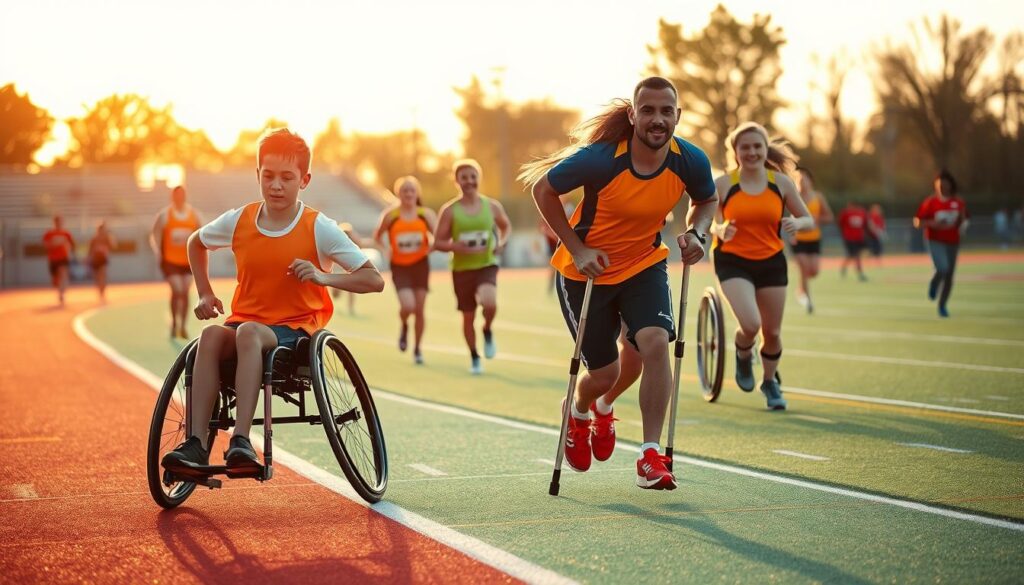
Team USA’s roller hockey players from Naples are another example. They keep their local league ties while competing globally. They show that excellence can be found in community, not just in isolation.
Adaptive figure skating is fascinating. Athletes talk about its mental challenges as much as physical ones. One skater calls it “chess on ice,” where every move is a complex calculation.
These aren’t just “overcoming disability” stories. They show how new systems lead to different paths to success. Athletes find their “sport home” where their abilities and challenges fit perfectly.
Adaptive rugby programs are also groundbreaking. They mix players with different abilities, rejecting old segregation. This creates a system where skills complement each other.
These athletes are not just inspiring. They’re leading a new way of thinking about human ability. They show us how sports can be designed to fit people, not the other way around.
The common thread in these adaptive sports stories? A move away from old, tired tales. These athletes are not defined by what they overcome. They are defined by what they create: new possibilities, communities, and definitions of athletic excellence.
Overcoming Barriers
We’ve been solving the wrong puzzle in adaptive sports. The barriers aren’t the athletes, but the invisible architecture around them. Traditional sports assume every family has disposable income for equipment and flexible schedules for practices. Southwest Florida programs are changing this with conscious design, leading to revolutionary results.
Financial barriers crumble through simple, elegant solutions. Naples BMX’s free loaner bike program operates on an honor system. No paperwork, no means testing, just pure accessibility. Roller hockey programs offer sliding scale fees, recognizing that economic diversity strengthens communities.
Transportation solutions have evolved beyond carpool spreadsheets. Programs now cluster practices geographically and partner with ride-share services. This makes getting to the venue easier than the sport itself. It’s a mix of urban planning and athletic development, benefiting both.
The most brilliant innovations happen in rule adaptation. Roller hockey eliminating off-sides isn’t just simplifying the game. It’s a philosophical statement against arbitrary complexity. Non-contact rugby versions maintain the sport’s essence while removing the intimidation factor.
Scheduling represents the final frontier of accessibility. Evening practices that don’t conflict with work schedules, weekend games that become family events. This shows programs’ commitment to real-world accessibility. The table below shows how innovative programs are reimagining traditional barriers:
| Traditional Barrier | Conventional Approach | Innovative Solution | Impact Level |
|---|---|---|---|
| Equipment Costs | Fundraising drives | Free loaner systems | High |
| Scheduling Conflicts | Fixed practice times | Flexible time blocks | Medium |
| Rule Complexity | Special exemptions | Rule simplification | High |
| Transportation | Carpool requests | Geographic clustering | Medium |
| Physical Requirements | Separate leagues | Adapted versions | High |
This isn’t about creating special accommodations. It’s about building better systems that work for everyone. The magic happens when we stop asking “how can we fit you into our model” and start asking “what would make this genuinely accessible.” The answer usually costs less than that $200 equipment bag collecting dust in your garage.
True accessibility means recognizing that the most impressive athletic feat might be a single mother getting her child to practice after two bus transfers. When programs remove those logistical hurdles, they’re not lowering standards. They’re raising the bar for what inclusive community design can achieve.
Impact on Families
The biggest change in youth sports isn’t on the field. It’s in the family minivan on the way home.
Krista Cianfrani, a figure skating mom, shares a shift: “Wednesday nights became about community, not competition. We’d laugh on the drive home instead of criticizing every missed jump.”
Rachel Pynnonen’s roller hockey story shows a financial win. “When equipment costs drop, sports stop being a status symbol. They become… well, fun.”
George Suarez’s BMX experience is unique. “Our track nights turned into block parties. Grandparents, cousins, neighbors all come. It’s like we found the community center we always wanted.”
The cost of traditional travel sports is high, over $5,000 a year. Inclusive programs cost 10-20% of that. This makes sports more accessible, not exclusive.
The sibling dynamic shift is profound. Programs for all abilities end the “star athlete vs benchwarmer” drama. Brothers and sisters can play together, free from comparison.
Parents start enjoying their kids’ sports events. The high-pressure environment of elite soccer fades, making it more like childhood.
This isn’t just about sports. It’s about rebuilding family culture around joy, not performance. The inclusive model lets everyone play without judgment.
Community connections become natural, not transactional. Families bond over shared experiences, not just winning. Wednesday night races are about connection, not medals.
Parents stop checking their phones during games. When joy is the goal, not scholarships, everyone is present.
This level of inclusion makes sports a family activity, not a stressful duty. Car rides home are filled with “what was your favorite part?” instead of “what did you do wrong?”
That’s the real victory. When sports become play for everyone, not just work.
How to Join or Support
Forget everything you know about youth sports recruitment – this isn’t the Hunger Games. Joining adaptive sports programs feels more like showing up to a party where everyone’s already cheering for you. No tryouts, no cuts, just pure participation.
Want to test the waters? Roller hockey happens Saturdays at Veterans Park – just show up. They’ve got equipment and coaches ready. BMX? Bring any bike to Naples BMX on Monday evenings. They’ll handle the rest while you focus on the ride.
The support system operates like a beautifully chaotic potluck dinner. Volunteers don’t need special expertise – just willingness. Donations fund specific equipment, not lost in red tape. Parents contribute professional skills: lawyers handling forms, marketers spreading the word, builders maintaining facilities.
Programs like Special Olympics Florida’s youth adaptive sports initiatives show how inclusive athletics build communities. Everyone brings what they can. These programs are not charity cases – they’re lessons in how sports should be.
The most radical support might be the informal time bank system. Parents give what they can when they can, creating a shared responsibility economy. It’s adaptive sports meets mutual aid society – and it’s brilliant.