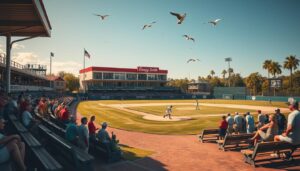
When people think of football powerhouses, they often picture Texas or Ohio. But Southwest Florida is a hidden gem. It’s a place where football legends are born.
Our athletes face challenges that would make others quit. They play in tropical downpours and sweltering humidity. It’s tough, but they thrive.
This isn’t just football. It’s a cultural phenomenon in our backyard. These programs are breeding grounds for Division I talent and NFL stars. Take Gregory Breston for example. He went from soccer to a kicking sensation.
We’re going to explore how Southwest Florida became a talent pipeline. It’s a story that deserves more attention.
The schools and eras that defined the region
While Miami and Orlando get all the attention, Southwest Florida has quietly changed football. The area’s football history is like a political shift, with three main groups. Each has its own way of doing things but aims for the same goal.
Fort Myers HS football is the old guard, laying the groundwork. They’ve built a dynasty while others focused on the beach. It’s amazing how they’ve grown.
Next, we have the rising stars. Port Charlotte is no longer just about pirate parades. They’re sending top talent to Texas. Cape Coral produces safeties who are sought after by Kansas.
The private schools bring a new twist. First Baptist Academy is not your typical private school. They excel in football and academics, impressing even Ivy League schools.
Each school has its own way of developing players:
| Program Type | Development Approach | Notable Success | Era Represented |
|---|---|---|---|
| Historic Public Schools | Community foundation building | Multi-generational talent pipeline | 1980s-2000s |
| Emerging Public Programs | District talent optimization | Power 5 conference signees | 2000s-2010s |
| Private Academies | Multi-sport specialization | Academic-athletic balance | 2010s-present |
East Lee County is another key player. They’ve transformed from an afterthought to a powerhouse, producing Division I athletes. Their growth shows how the region has changed from a football newcomer to a talent hub.
The beauty of SWFL football is its diversity. Public schools focus on community talent. Private schools specialize in football through multi-sport athletes. It’s like different political parties working together but each winning their own way.
This diversity makes SWFL unique in Florida. Unlike other areas with one dominant style, SWFL’s variety lifts all boats. This leads to more talent, better games, and a region that outperforms its size.
Coaching philosophies and community support systems
Think football is just about X’s and O’s? You’ve clearly never seen the Dunbar program in action. These coaches are more like Tony Robbins with a playbook.
Their philosophy goes beyond the field. It’s about building mental strength as much as physical. They create support networks that rival those of Fortune 500 companies.
Myron Charles’ recruitment story is a prime example. Texas didn’t just recruit him; they brought in his whole family. That’s not just football strategy; it’s building alliances on a Friday night lights scale.
Darrion Jones talks about his support system “knowing no bounds.” This shows the heart of these programs. It’s the difference between hiring a contractor and building a family dynasty.
These coaches do more than just coach. They act as psychologists, mentors, and life coaches. Players learn that football is temporary, but character lasts forever.
| Program Element | Traditional Approach | Dunbar Philosophy |
|---|---|---|
| Player Development | Physical training only | Mental + physical conditioning |
| Family Involvement | Occasional parent meetings | Integrated family support system |
| Community Role | Friday night entertainment | 365-day support network |
| Coach’s Function | X’s and O’s specialist | Life coach + strategist |
The community support system is like a well-oiled machine. Local businesses sponsor meals. Alumni offer mentorship. Even band parents help with tutoring.
This isn’t just football. It’s a model for what community support should be. The coaching philosophy knows that champions aren’t made in weight rooms alone—just like the approach highlighted in coaching and mentorship.
They’re built in relationships that last through tough times and victories. That’s the real Dunbar difference.
Training in heat and storms: The SWFL advantage
In North Fort Myers, kids train in real, tough weather. It’s not about fancy facilities. It’s about facing Southwest Florida’s harsh weather head-on.
When it’s 95° and 90% humid, every practice is a test. Players learn to push through pain. It’s about survival and getting better.
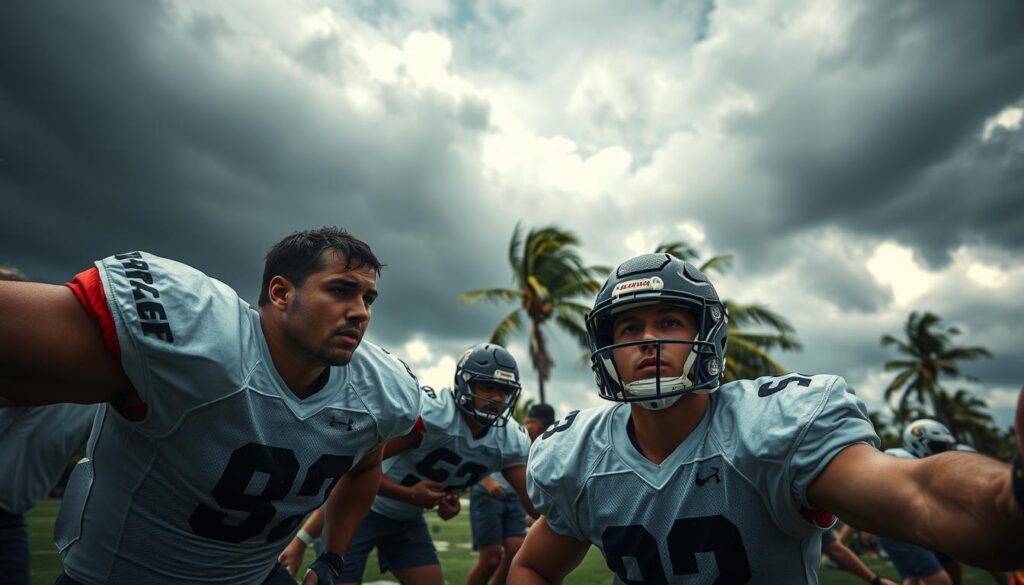
Thunderstorms add to the challenge. One minute it’s hot, the next, you’re dodging lightning. It’s not just hard—it’s a chance to learn to adapt.
X3 Performance chose North Fort Myers for a reason. NFL prospects come here to get tough. They learn to handle the heat and stay strong in tough conditions.
The benefits are clear:
- Heat adaptation: Players can handle more heat than others
- Mental toughness: They get used to discomfort
- Recovery superiority: They cool down fast, even when it’s hot
Our tough weather turned into a big plus. While others try to simulate it, we live it every day. Our players don’t just handle pressure—they thrive on it.
Rivalries and the games that shaped legacies
If Friday night lights are SWFL’s religion, then rivalry games are its high holy days. These aren’t just sports games. They’re cultural events where whole communities wait with bated breath for 48 minutes. The excitement is so high, it’s like nothing else matters.
The Immokalee-Fort Myers showdown is more than football. It’s a clash of cultures, economies, and identities. I’ve seen men cry during these games. It’s not just the food at the concession stand.
These rivalries are intense. They can make players into diamonds or dust. It’s not just about winning. It’s about family pride, neighborhood bragging rights, and sometimes college scholarships. The Port Charlotte-Punta Gorda games are like global conflicts but with better uniforms.
What makes these games special? The stakes are huge. Legends are made in the fourth quarter, where every play matters. College scouts look for heart, not just talent.
The mental strength gained in these games is priceless. Surviving an Immokalee rivalry week makes Big Ten Saturdays seem easy. These games don’t just build athletes. They build characters ready for life’s challenges.
Rivalry games turn boys into men and players into legends. The lessons learned go beyond the field. They create stories that communities remember for generations.
Alumni spotlights and “where are they now?”
The trophy case at X3 Performance is more than just a display. It shows the strength of SWFL’s football community. Kids who once played on sandy fields now shine under the NFL lights. Their stories are not just inspiring; they prove SWFL’s resilience.
Imagine a kid who went from evacuating for hurricanes to studying NFL blitz packages. Or another who chose Power 4 stardom over Division III offers. These are not just stories; they show SWFL’s development model works at all levels.
The NFL alumni wall at X3 Performance only tells part of the story. What’s more important is what happened after the photos were taken. It’s about those who turned SWFL’s challenges into professional wins.
Think of the offensive lineman who learned footwork in mud. Now, he handles NFL pass rushers with ease. Or the receiver who practiced routes during tropical storms. Today, he catches touchdowns in tough conditions.
These NFL alumni stories share common traits: hard work, adaptability, and SWFL grit. They’re not just success stories; they’re blueprints for success.
From Franklin and Marshall signings to first-round draft picks, the range of NFL alumni achievements is key. SWFL doesn’t just produce players; it creates survivors who excel under pressure.
The real magic is in how kids adapt from playing in front of 500 fans to 70,000. SWFL’s unique preparation methods are the answer.
These NFL alumni aren’t just making plays on Sundays. They’re building legacies that inspire future SWFL talent. Their success shows that SWFL’s challenges create unique advantages.
Looking at the NFL alumni wall is more than seeing photos. It’s seeing proof that SWFL’s football culture creates professionals who excel in adversity.
The “where are they now” question gets answered every Sunday. And the answers keep getting more impressive each year.
Recruiting evolution: Camps, 7-on-7, and scouting
Remember when recruiting was all about mailing VHS tapes? Those days are gone, like Blockbuster Video. Now, recruiting SWFL is as complex as a spy movie.
The shift from old-school to digital recruiting is like our own tech leap. But instead of gadgets, it’s all about sweat and cleats.
- VHS Era: Coaches got grainy tapes with scribbled labels. Often, the tape would get stuck in the VCR.
- DVD Transition: The quality improved, but it was all about the mail and how long coaches watched.
- Digital Revolution: Now, Hudl highlights are sent instantly. Coaches can watch your game before you’ve even dried off.
7-on-7 tournaments are no longer just games. They’re where college coaches find talent like it’s Black Friday. Every move is analyzed by eager coaches.
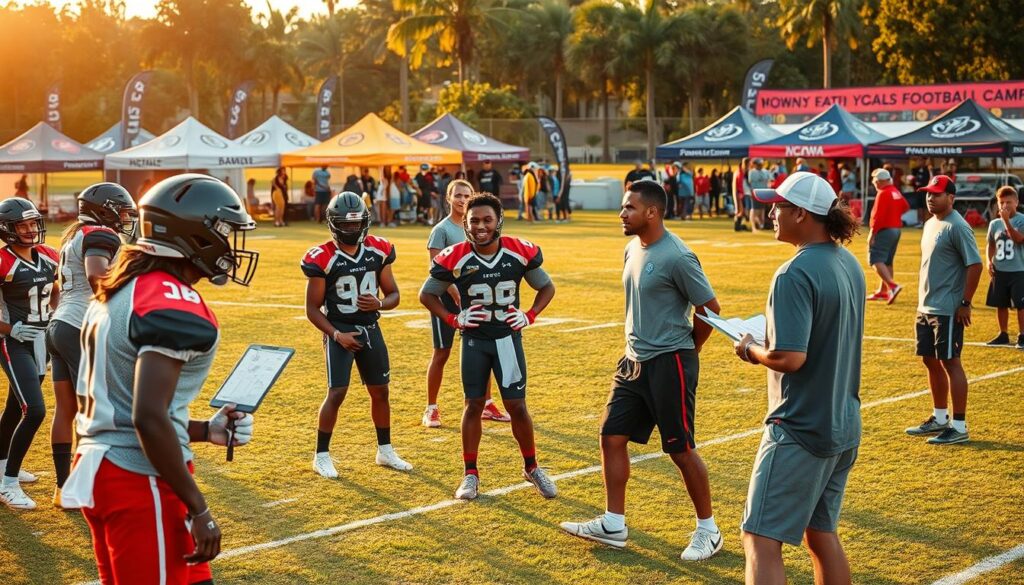
Camps have changed too. They’re not just summer fun. They’re prep for combines, starting in freshman year. The drills and tests are all about data for recruiters.
The scouting has become super advanced. It’s all about tracking, social media, and building relationships. Texas’s pursuit of Myron Charles while he was committed to FSU was like a strategic operation.
What makes SWFL recruiting special? Our kids come from areas not known for football. They don’t get the same attention as kids from Texas or Florida. This makes them hungrier and more determined.
These players work harder to get noticed. They go to more camps and perform better at combines. They know they have to earn everything.
The evolution keeps going. Recruiting SWFL talent is a year-round job with its own world of trainers and events. It’s not just about finding players; it’s about turning them into valuable assets for colleges.
This system offers both chances and challenges. Kids get noticed early, but they face more scrutiny than ever. The game has changed, and SWFL recruiting is right in the middle of it all.
NIL, transfers, and modern challenges
Welcome to the Wild West of SWFL football. Here, NIL deals and transfer portals have made recruiting a high-stakes game. Coaches must think like chess grandmasters and negotiate like Wall Street pros.
The NIL revolution hit Southwest Florida like a storm that never leaves. Now, high school athletes have more financial advisors than college offers. Local businesses sponsor players like minor league stars.
Remember when a handshake was enough? The transfer portal changed that. Myron Charles’ move from FSU to Texas wasn’t a betrayal—it was business. Today, athletes view recruitment like stock traders.
Coaches now teach financial literacy and focus on keeping players. How do you keep a player focused on Friday night lights when Instagram offers Saturday pay? The answer involves more psychology than football schemes.
SWFL programs compete with collectives and booster networks from other states. It’s not just about winning games. It’s about making business proposals to seventeen-year-olds with brand value.
The transfer portal is like a machine of roster chaos. Your star quarterback might leave for Arkansas for a better NIL deal. Coaches need plans for their plans.
Yet, there’s opportunity in this chaos. SWFL athletes turn their talents into financial security. Local businesses connect with future stars. The system is messy, but it’s fascinating to watch evolve.
This isn’t your grandfather’s Friday night football. It’s a mix of athletics, economics, and community. Teams that adapt will thrive. Those stuck in the past might get left behind in this new era of SWFL football.
Fan culture: Bands, tailgates, and traditions
SWFL football may not have fancy production, but it has something special. It’s a raw, heartfelt fan culture that can’t be bought. This is different from the polished, corporate feel of big-time college football.
Tailgates here are real gatherings, not fancy events. Families grill burgers and share stories for generations. The smell of charcoal fills the air, not fancy catering.
High school bands play with a charm that’s hard to find. The humidity makes their music a little off-key. But it sounds more real than any perfect recording.
These traditions grew over years, not from focus groups. They show what’s important about Friday night football.
Lazaro Rogers’ signing at Dave and Busters was a true moment. It wasn’t a staged event. It was a celebration of community in a real place.
The fan culture here supports players in ways stats can’t. It’s football with heart, not just shows. The passion is genuine, not made up.
In a world where college sports feel like products, SWFL football stands out. It’s real, not polished. And in today’s world, being real is rare.
What’s next for SWFL football
So, where does SWFL football go from here? It looks like the region is becoming a top spot for college scouts. The mix of great player development, unique settings, and new facilities like X3 Performance is creating a perfect storm.
The next decade might see SWFL rivaling other Florida powerhouses. Young players now get better coaching, more chances to shine, and top-notch training spots. The path from high school to college to the NFL is stronger than ever.
The real question is how many stars SWFL will produce and when. History suggests the answer will be more than expected, and sooner than thought. SWFL football is not just rising; it’s here to stay.