In Southwest Florida, a strong movement is growing. It’s fueled by volunteers and trainers who help athletes with intellectual disabilities.
Florida has over 86,738 athletes training and competing all year. This community depends on coaches to create a respectful and dignified environment for everyone.
Your work as a coach is transformative. This guide will help you on your rewarding path. We’ll cover the key parts of being a great Special Olympics coach.
You’ll find out how to get certified and create flexible practice plans. We’ll also share inclusive drills that help athletes of all levels succeed.
Coaching Pathways: roles, prerequisites, certifications
Becoming a certified coach for Special Olympics in Southwest Florida has specific steps. These steps vary based on the role and sport you choose. You join a huge support network. Special Olympics Florida has over 55,839 volunteers and coaches statewide.
This setup makes sure every athlete gets top-notch training. Your journey begins by picking a role that matches your skills and dedication.
Available Coaching Roles
Special Olympics has several positions. Each role is key to the team’s success.
- Head Coach: Oversees the program. This role plans practices, talks to families, and guides other coaches.
- Assistant Coach: Helps the head coach during sessions. They often work with small groups of athletes.
- Unified Partner Coach: A special role for volunteers who train with athletes. They help make Unified Sports teams inclusive.
All roles need a heart for service and a commitment to the mission. The certification steps are similar, but the duties vary.
Universal Prerequisites
Before starting sport-specific training, you must complete two things. These steps protect you and the athletes.
- Background Screening: A must for all volunteers. Special Olympics Florida handles this process.
- Protective Behaviors Training: A free online course. It teaches how to spot and report abuse. This training is vital for athlete safety.
After these are done, you can focus on your sport coaching certifications.
Follow this clear path to become a fully certified Special Olympics coach in SWFL.
- Contact Your Local Program: Reach out to the Special Olympics Florida Southwest region. They will connect you with a local coordinator.
- Complete Prerequisites: Finish your background check and Protective Behaviors course online.
- Choose Your Sport: Pick a sport you love, like basketball, swimming, or Competitive Cheer.
- Attend a General Orientation: Learn the core values, philosophy, and policies of Special Olympics.
- Complete Sport-Specific Training: Take the official certification course for your chosen sport. Many are online or in local clinics.
- Get Hands-On Experience: Start coaching with a veteran mentor at practices.
Let’s look at Competitive Cheer as an example. It’s a Recognized Sport for both traditional and Unified teams. A coach needs the general prerequisites and the “Competitive Cheer Coach” certification. This ensures they know cheer safety, routines, and inclusive adaptations.
The table below summarizes the key details for the primary coaching roles.
| Coaching Role | Primary Responsibilities | Core Prerequisites | Required Certification |
|---|---|---|---|
| Head Coach | Plan season, lead all practices, manage team logistics, primary communicator. | Background Check, Protective Behaviors Training | Sport-Specific Certification, General Orientation |
| Assistant Coach | Support head coach, run skill stations, provide athlete encouragement. | Background Check, Protective Behaviors Training | General Orientation (Sport-Specific recommended) |
| Unified Partner Coach | Train as a teammate, model sportsmanship, foster inclusive team dynamics. | Background Check, Protective Behaviors Training | Unified Sports Training, General Orientation |
The entire certification process is designed to be easy. Local staff help at every step. You’re never alone. With your certification, you’ll be ready to make a positive impact.
Your next step is learning how to run safe and inclusive practices. This foundation prepares you for the exciting challenge ahead.
Safe & Inclusive Practice Basics: cues, visuals, routines
Creating practice templates for all abilities needs three main things: clear cues, visual aids, and routines. These elements make every athlete feel safe and ready to learn. This approach is used in all Special Olympics sports in Southwest Florida.
A safe place has two parts. The area must be safe and have clear rules. Mats are needed for floor work. And, check the equipment before using it.
The emotional space is also key. Coaches should be respectful and encouraging. Use positive words that focus on effort, not just winning. Celebrate small wins to build confidence.
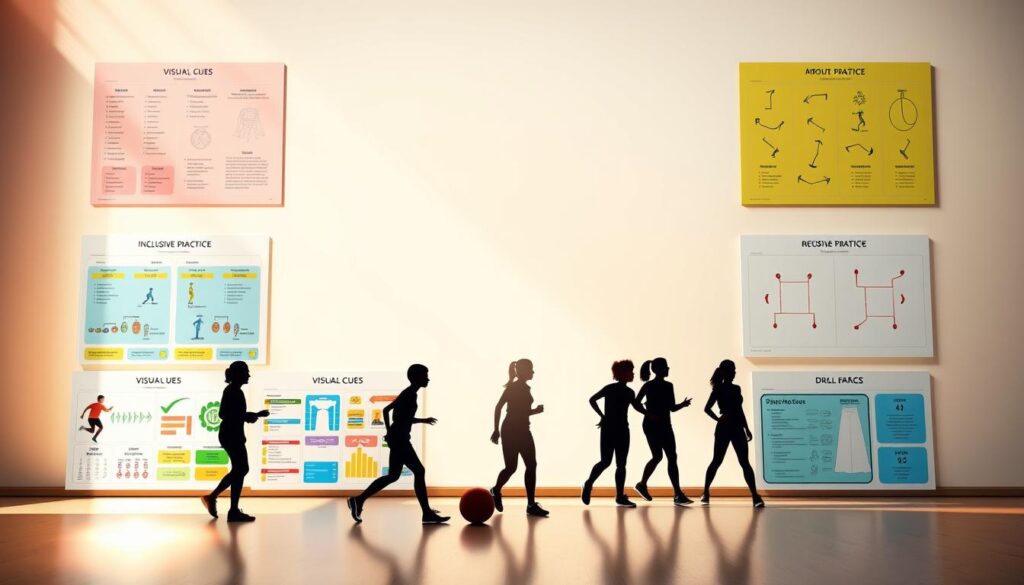
Verbal cues are your main tool. They should be simple, clear, and always the same. Instead of saying “Let’s get those arms up during the jump,” say “Arms up, then jump.”
Always use the same words for the same action. This helps avoid confusion. Pair your words with actions whenever you can. Speak clearly and at a good pace.
Visual aids help athletes who like to see things. Showing the skill slowly, step by step, is very helpful. Picture schedules are great for showing the practice order. They help athletes know what’s next and feel less anxious.
Charts with photos of correct movements are also useful. You can put them on the wall or on a clipboard. They make hard instructions easier to understand.
Consistent routines give a sense of order. Athletes like knowing what’s coming next. Start and end each practice the same way. Use a familiar greeting and a consistent cool-down activity.
Keep the order of activities the same. For example, always do dynamic warm-ups, then skill stations, then a fun game. This predictability lets athletes focus on learning, not on wondering what’s next.
Let’s see how this works in a real sport. Competitive Cheer has Routine and Game Day events across four levels. A coach uses the same practice templates for all levels, adjusting the difficulty.
For a stunting drill, the cue is “Base, ready. Flyer, step. Spot, hands up.” A visual aid shows the starting positions. The routine is that stunting practice always comes after tumbling. This consistency helps athletes move between levels smoothly.
The table below shows a sample practice template structure. You can change the activities for any sport.
| Time Block | Activity | Primary Cue | Visual Aid Used | Adaptation Note |
|---|---|---|---|---|
| 0-10 min | Welcome & Dynamic Warm-up | “Circle up, follow me” | Coach demonstration | Offer seated warm-up options |
| 10-25 min | Skill Station 1 (e.g., Passing) | “Two hands, push the ball” | Picture sequence on clipboard | Use larger/lighter ball as needed |
| 25-35 min | Water Break & Transition | “Hydrate, then line up” | Picture schedule showing break | Use timer for visual countdown |
| 35-50 min | Skill Station 2 (e.g., Shooting) | “Aim, bend knees, shoot” | Target chart on wall | Lower basket or use closer line |
| 50-60 min | Fun Game & Cool-down | “Game rules: pass to everyone” | Diagram of playing area | Modify rules for full inclusion |
This template keeps practices safe and fun. It includes notes for making things easier for everyone. The visual aid column helps coaches prepare ahead of time.
Good practice templates are flexible. They keep the basics the same but change the activities and details. This makes them work for any sport and athletes.
Begin your next practice with these basics in mind. Write down your key cues. Prepare a new visual aid. Stick to a routine. You’ll see your athletes get more involved and understand better.
Sport‑Specific Mini‑Drills (3 per sport)
This collection of sport-specific activities offers coaches concrete tools to develop fundamental skills through unified teamwork. The following mini-drills are designed to be easily adapted, ensuring every athlete can participate and succeed. Each drill emphasizes the principles of unified coaching, creating opportunities for meaningful partnership and shared achievement.
- Skill Focus: Arm drive and knee lift for sprinting.
Equipment: Cones.
Drill: “High Knees & Go!” Athletes march in place with high knees for 10 seconds, then sprint to a cone 20 meters away. Partner athletes can run alongside, matching pace and giving verbal cues like “Drive your arms!” - Skill Focus: Underhand throwing motion for softball.
Equipment: Softballs, hoop or target on ground.
Drill: “Bucket Toss.” Athletes practice underhand toss to land a ball inside a hoop. Start close, then step back. For modifications, use larger balls or allow a two-handed throw. - Skill Focus: Standing long jump take-off.
Equipment: Tape or chalk line.
Drill: “Jump the Creek.” Mark two lines as a ‘creek.’ Athletes jump from one line to the other. Widen the creek for a challenge. Unified partners can jump simultaneously, aiming to land together.
Swimming: Water Confidence & Propulsion
Develop comfort and basic stroke techniques in the water.
- Skill Focus: Front float and breath control.
Equipment: Kickboards, pool noodles.
Drill: “Face Down Float with Support.” Athletes hold a kickboard, put their face in the water, and float for 5 seconds. Partners can offer a hand for stability. Gradually increase float time. - Skill Focus: Flutter kick for freestyle.
Equipment: Kickboards.
Drill: “Kickboard Relay.” Athletes push a kickboard across the pool using only their flutter kick. In Unified teams, partners can kick side-by-side, racing another pair. - Skill Focus: Arm recovery for backstroke.
Equipment: None.
Drill: “Backstroke Walk.” Athletes walk backwards in the chest-deep water, practicing the big arm circles of backstroke. Partners walk facing them, providing a visual guide and ensuring safety.
Basketball: Ball Handling & Team Play
Enhance coordination, passing, and simple offensive concepts.
- Skill Focus: Dribbling with control.
Equipment: Basketballs, cones.
Drill: “Dribble Tag.” In a defined area, athletes dribble while trying to avoid being tagged by a coach or partner. If tagged, they perform 5 stationary dribbles before re-joining. This promotes ball control under mild pressure. - Skill Focus: Chest pass accuracy.
Equipment: Basketballs.
Drill: “Pass & Pivot.” Athletes pair up. One passes, then practices a pivot foot. The receiver passes back. This drill fosters the essential unified coaching dynamic of direct partner interaction and feedback. - Skill Focus: Lay-up steps without the jump.
Equipment: Basketball, hoop (lowered if available).
Drill: “Step-Up Lay-up.” Athletes practice the “1-2” step pattern to the basket, finishing by placing the ball on the backboard. Use visual markers on the floor for steps. Partners can rebound and hand the ball back.
Competitive Cheer: Unified Team Building
As a sport that offers competition for both traditional and Unified teams, cheer drills build synchronization, trust, and spirit.
- Skill Focus: Synchronized arm motions.
Equipment: None.
Drill: “Mirror Motion.” Partners face each other. One leads slow, sharp arm motions (high V, low V, touchdown). The follower mirrors. Then switch leaders. This builds non-verbal communication and unity. - Skill Focus: Building a simple stunt base.
Equipment: Mats, spotter.
Drill: “Assisted Sit-Stand.” In a group, athletes form a base to gently assist a fellow athlete from a seated to a standing position. Focus on steady support and clear “ready, lift” commands. This teaches the foundation of weight-sharing and trust. - Skill Focus: Chanting with clear diction and energy.
Equipment: Printed chant lyrics.
Drill: “Echo Chant.” The coach or a leader calls out one line of a cheer. The whole team echoes it back with matching claps. This ensures everyone can learn and participate at the same pace, a core goal of unified coaching.
These drills are starting points. The most effective unified coaching happens when you observe your athletes and adjust. Simplify a skill, add a challenge, or change the equipment. The goal is always active participation and shared joy in the sport.
Communication with Families and Support Staff
Coaching is more than just the game. It’s about talking clearly with families and support staff. Your role links the athlete’s sports life to their everyday world. This partnership is key to a positive and effective program.
Creating an inclusive world needs everyone’s help. This starts with good communication. A unified coaching approach sees parents, guardians, and personal care attendants as part of the team.
Start with a meeting before the season begins. It can be a quick chat after practice or a scheduled call. Learn about the athlete’s strengths, likes, and needs. Listen more than you talk to build trust and show you value their input.
Keep everyone updated with regular messages. A weekly email or a team app message works well. Share the good stuff, like when an athlete learns something new or shows teamwork. This shows you see the whole person.
Getting ready for games needs extra planning. Share schedules, uniform needs, and travel details early. Confirm who will be there and where to meet. This helps reduce stress on game day.
Creating a “team family” atmosphere makes everyone feel included. Encourage families to support all athletes, not just their own. Host events like potlucks or meet-and-greets. This builds a community where support is shared freely.
Here are some tips for unified coaching communication:
- Be Proactive: Reach out first. Don’t wait for a question or concern to arise.
- Be Positive: Frame feedback constructively. Celebrate effort as much as achievement.
- Be Clear: Use simple, direct language. Avoid coaching jargon when speaking with families.
- Be Inclusive: Copy all relevant parties (e.g., both parents, a therapist) on important messages.
- Be a Connector: Introduce families to each other. This strengthens the overall support network.
This approach turns a group into a united team. When coaches, families, and support staff work together, the athlete does well. This is the heart of unified coaching in Southwest Florida.
Competition Day Coach Checklist
With Special Olympics Florida hosting 159 competitions annually, having a reliable practice template for event day is non-negotiable. The energy and logistics of game day demand flawless execution. A detailed coach checklist transforms chaos into a smooth, athlete-focused experience.
This checklist serves as your essential practice template. It guides you through three critical phases: pre-departure, on-site responsibilities, and post-competition protocols. Covering each phase ensures nothing is forgotten and every athlete is supported.
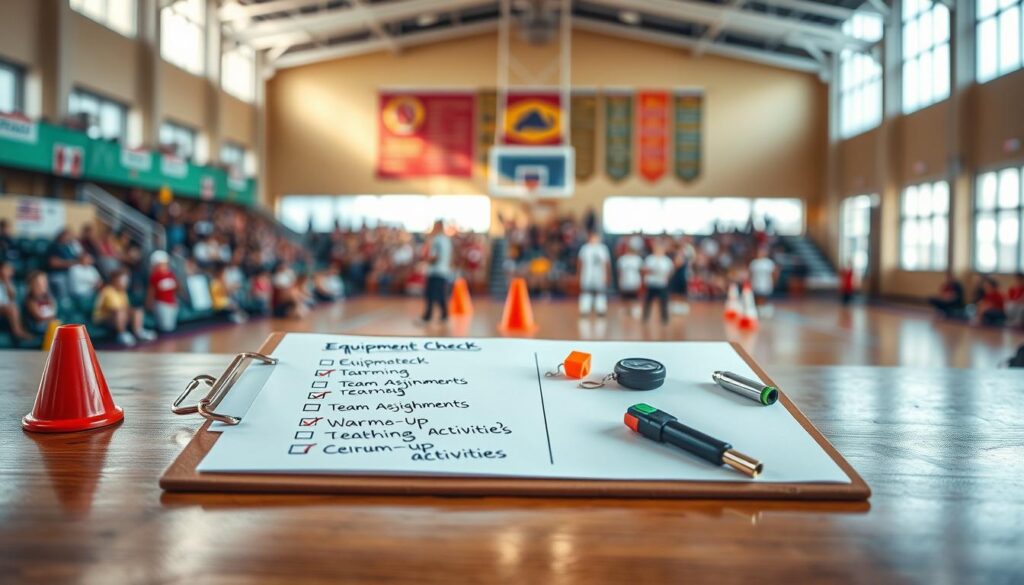
Use the following table as your operational blueprint. It outlines the core tasks for each stage of competition day.
| Phase | Key Tasks | Notes & Details |
|---|---|---|
| Pre-Departure |
|
Complete this 24 hours before leaving. Designate a “go-bag” for last-minute items. |
| On-Site |
|
Arrive at least 90 minutes before the first event. Use visual schedules for athletes. |
| Post-Competition |
|
Focus on effort and sportsmanship. This is a key moment for positive reinforcement. |
The season’s pinnacle is often the State Games. The Guardians of the Flame torch relay culminates at the Opening Ceremony. Your checklist ensures athletes are ready to perform their best when that moment arrives. Proper planning lets them fully enjoy the spectacle.
After competition, the debrief is critical. Discuss what went well and note adjustments for next time. This reflection turns a single checklist into a living document. It improves your process for every future event.
Celebrating achievements strengthens team bonds. Recognizing every athlete’s effort makes them feel like true champions in our community. Save your annotated checklist. It becomes a proven, reusable practice template for success at any of the 159 competitions.
Stories from Local Coaches (permissions)
The real impact of Special Olympics coaching in Southwest Florida is seen through the coaches’ personal stories. These tales show the joy, determination, and deep connections that make it special. We got permission from SWFL coaches to share their experiences, keeping their identities private.
This way, we keep the stories real and respect everyone’s privacy. The stories we’ve gathered show the essence of Special Olympics coaching.
| Story Theme | Coach Insight | Lasting Impact |
|---|---|---|
| The First “I Did It!” | A coach shared a moment when an athlete caught a softball on their own after weeks of practice. It was a look of joy that mattered most. | This victory boosted the athlete’s confidence, helping them support their teammates too. |
| Overcoming a Fear | One coach helped a swimmer face their fear of water. They started with blowing bubbles and eventually swam a full lap. | This showed the swimmer that overcoming fear is possible, one small step at a time. |
| The Unseen Victory | A bocce coach said the biggest win was when an athlete started greeting and talking to opponents. | This victory showed how sports can help people connect and grow socially. |
One coach talked about a track athlete who had trouble starting. “We used a bright orange cone as a visual ‘go’ signal instead of a starter’s pistol,” they said. When the athlete took off right, the whole team cheered. It was a win of adapted communication.
Another story is about a basketball player who could shoot in practice but froze in games. The coach focused on catching and passing instead. “We celebrated every completed pass like it was a game-winning shot,” the coach said. By the end of the season, the player was eager to get the ball.
These stories reflect a global movement. The 2026 Special Olympics USA Games in Minnesota will highlight thousands of similar stories. This event will inspire and change lives, thanks to the same coaching principles used in SWFL.
How many lives are changed by this work? Every single one, say the local coaches. Athletes grow, families find support, and coaches witness incredible human spirit. These stories are the heart of the mission.
Links: certification portals, clinics, contacts
This resource hub is your starting point for coaching. It offers all the tools you need to get involved in Southwest Florida.
The official Special Olympics Florida certification portal is your go-to. Visit their website to see what you need to do. They have online modules for both new and returning coaches.
Local coaching clinics happen all year in SWFL. These workshops give you sport-specific training. Check the Special Olympics Florida event calendar for clinics in Fort Myers or Naples.
Need help? Contact your local area coordinator. They can guide you through the certification steps and team building. The Special Olympics Florida Southwest Florida office has email addresses and phone numbers for coordinators.
Learn about big initiatives like the 2026 Race For Champions campaign. Supporting Team Florida for the USA Games is another way to help.
Now you know what to do. Use these links to get to the certification portal, find a clinic, and reach out to local staff. Taking these steps makes you a dedicated coach for inclusion.