Forget the postcard sunsets. The real pulse of this place isn’t just in the gentle Gulf waves.
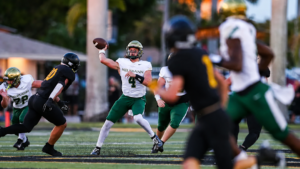
It’s in the crack of a bat at Hammond Stadium and the primal shout from a Friday night football sideline. It’s in the silent, intense focus of an angler landing a tarpon. This is the raw, unscripted drama I hunt.
My tool isn’t a mitt or a fishing rod. It’s a camera. I’m here to dissect the spectacle. Think of this less as a gallery and more as an anthropological study—a witty field report from the trenches of our community competition.
Why does that minor league baseball game, a cherished tradition where friends gather, matter so much? What story does a mud-streaked jersey tell? This is my mission: to move beyond standard sports photography.
It’s about capturing moments that words can’t. It’s the visual biography of a region’s passion, shot through an analytical, slightly skeptical lens. Let’s get started.
Role of Photography in Local Sports
Newspapers are shrinking, and game recaps are getting lost online. But the camera lens has become our main sports storyteller. It’s the last one telling the story when the press box is empty. It’s not just about taking pictures; it’s about keeping our memories alive in a world full of digital noise.
The role of local sports photography is complex. It’s a mix of historian, therapist, and myth-maker. The historian records the event, like the sweat and the final score. The therapist captures the emotions, showing the highs and lows of sports. The myth-maker turns ordinary plays into legendary moments.
Photography captures moments that words can’t. A action shot shows the intensity of a play, not just the outcome. It’s like emotional archaeology, uncovering the drama in sports.
In ten years, who will remember a specific play from the 2023 district finals? But a photo makes that moment unforgettable. It turns a forgotten story into a lasting memory. These images are like digital cave paintings, proof of our sports history.
Let’s look at what a photo does versus what we think it does. The table below shows the difference between the surface-level and the deeper impact on our community.
| Perceived Function | Real Role | Community Impact |
|---|---|---|
| Capturing the play | Creating a visual timestamp; turning a sequence into a singular, defining action shot. | Provides a common reference point, a shared “I was there” moment for fans and players alike. |
| Freezing emotion | Performing emotional validation; making private joy or anguish a public, connective experience. | Fosters empathy and shared identity, strengthening the bond between the team and its supporters. |
| Documenting the event | Acting as primary-source evidence; building the unofficial, visual archive of local sports history. | Ensures legacy. Future generations can see, not just hear about, the athletic culture that shaped their town. |
The camera does more than just watch. It constructs our memories. It shapes the chaos of a game into something we can hold onto. In a world where local achievements are often forgotten, these photos are the foundation of our sports heritage. They prove that our moments of glory were worth remembering.
Iconic Images and the Stories Behind Them
In Southwest Florida, some sports images are legendary. They’re not just about the photo itself but the stories they tell. These images capture the essence of a game, a season, or a lifetime of hard work.
Capturing these moments requires more than just a camera. It needs context. A photo of a softball player sliding home is just a shot. But add the details like a tied game and a coach’s motivational words, and it becomes a story of pressure, family, and sports.
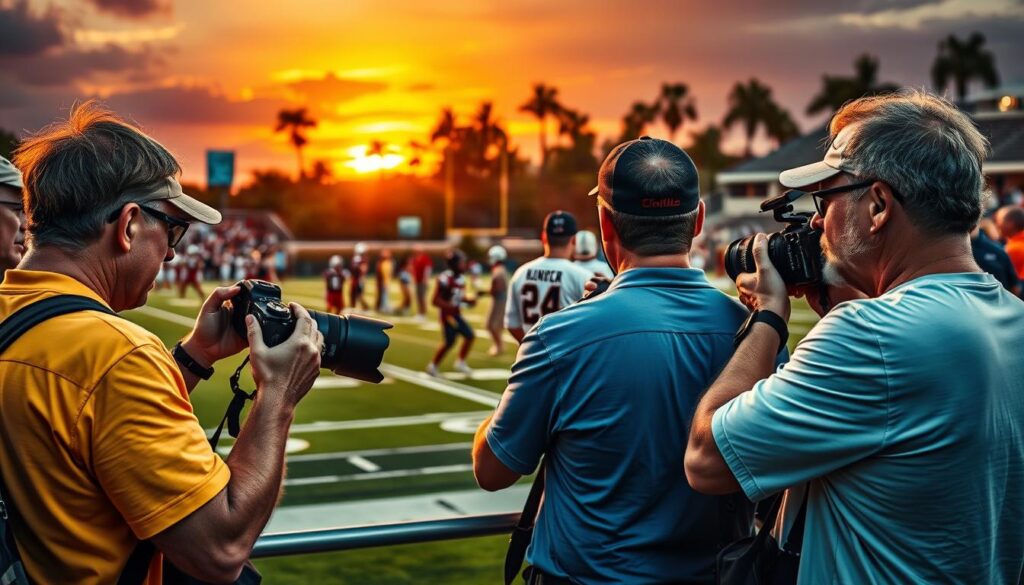
Let’s look at a few local masterpieces. Imagine a veteran surfer, set against a dawn sky, riding a wave. The photo is stunning. But the story is about overcoming pain and personal struggles.
These photos are never just luck. They come from dedicated photographers who see beyond the game. They capture the moments that tell a deeper story, like a glance or a hug between rivals.
What makes a photo iconic? It’s not just the lighting. It’s the story behind it, like the heat, the food, and the crowd’s roar. These details make the photo unforgettable.
Our local team photographers are more than just photographers. They’re storytellers who capture the essence of sports. Their photos are not just for show. They’re a reminder of our community’s spirit.
Profiles of Well-Known Local Sports Photographers
Photographers at local games are unique, driven by more than just the game’s outcome. They turn sweat, mud, and emotions into lasting images. Who are these sideline geniuses, and what magic do they bring?
It’s not about the camera. It’s about the passion. Why do they choose to spend their Saturdays capturing the perfect moment? It’s a mix of living vicariously, artistic frustration, and love for human effort.
They focus on specific moments. Some aim for the game-winning catch. Others, like Marcus Thorne, capture the anticipation. He calls it “the shot before the shot,” where the game’s true action happens.
Thorne, a former college player, sees the game through his lens. He’s not just taking pictures; he’s translating a language he once knew well. His goal is to capture the moment a rookie player finds focus.
Thorne has been chasing this sports visual for 12 seasons. He looks for the shift from fear to focus in a player’s eyes. “It’s in the eyes,” he says, “the moment they become hunters.”
Elena Silva’s journey is inspiring. She left a corporate job in Miami for a camera and a new life in Southwest Florida. She started with her nephew’s little league games, finding a new world of color and emotion.
Silva loves capturing the moments after the game. She focuses on the celebrations and the reactions. “The action is the headline,” she says, “but the reaction is the story.” For her, photography is a way to witness and frame humanity.
Thorne and Silva represent two sides of the same passion. One is an insider, the other an outsider. They share a love for capturing time. They’re not just stopping it; they’re giving it meaning.
They create our shared visual memory. Next time you see a stunning photo of a local game, think about the photographer. Their passion gives our community’s athletic soul a face and a lasting impact.
How Photographs Build Community Spirit
Forget town hall meetings; the real civic engagement happens through the lens at a Friday night football game. Politicians debate policy, but on the field, a different politics plays out—the politics of belonging. A great piece of local sports photography boosts morale more than any official proclamation.
That gathering at the stadium with friends and loved ones? It’s a cherished tradition. The community is friendly, connecting locals and visitors. A photograph captures that feeling, making it permanent and shareable.
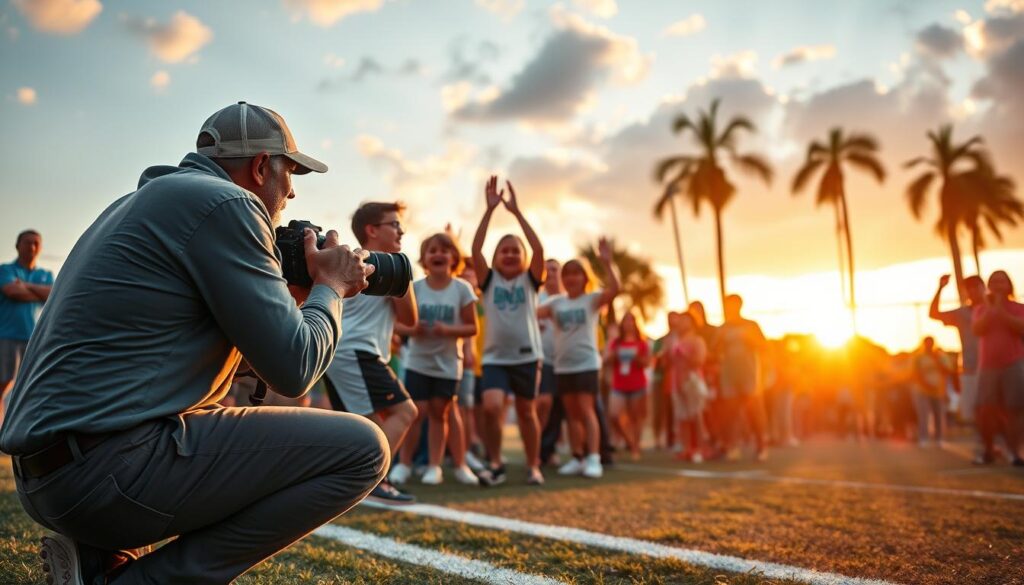
A single image from a little league game is social glue. It gets shared on Facebook, printed in the local paper, and displayed at the diner. Suddenly, everyone has a common visual language. That kid making an impossible catch? He’s our kid. The triumphant coach? He’s the high school history teacher.
Photography bridges the gap between spectators and players. It turns “them” into “us.” This isn’t just observation; it’s alchemy. In our fragmented digital world, these visuals create a powerful micro-community of pride and identity.
It’s visual patriotism, but for your zip code. This form of connection is what makes creative uses for youth sports photographs so valuable. They’re not just family mementos; they’re the artifacts of our shared story.
So, the next time you see a great sports photo from your town, don’t just like it. Recognize it for what it is: the quiet, relentless work of building a community, one snapshot at a time.
Tips for Budding Sports Photographers
Welcome to the world of sports photography, where planning and patience are key. This isn’t about f-stops. Instead, it’s a guide to capturing the chaos of sports into beautiful images. It comes from seasoned photojournalists.
Your first lesson is not about your camera. Your access pass is your most vital piece of equipment. Without it, you can’t tell your story. Building trust with organizers, coaches, and security is essential. It’s about showing you’re reliable, not a problem.
The heart of sports photography is anticipation, not just reacting. The real story is often not where the ball is, but where the emotions are. Train your eye to follow the emotional journey, not just the action.
- Watch the bench: The raw emotions of a substituted player reveal more than the game itself.
- Find the coach: A clenched fist or a head in hands tells a story of the game’s intensity.
- Scan the crowd: A single fan’s reaction can capture the season’s tension.
Now, let’s talk about the elements. Sunny days are for tourists. Embrace the bad weather. Rainy uniforms, mud, and stormy skies add drama to your photos. It’s where grit meets poetry.
Your presence should be subtle. Use long lenses and blend in to capture real moments. People act differently when they’re not aware of a camera.
And remember, ethics are important. When shooting youth sports, it’s about preserving innocence. Always ask for permission. Your photos should celebrate, not intrude.
Lastly, don’t rush. The best photos are often taken after the game. The exhausted embrace, the solitary walk, and the scattered equipment tell a story that continues long after the game ends.
So, prepare more than just your camera. Prepare with foresight, empathy, and patience. That’s how you master sports photography.
Fan Submissions and Highlights
Forget the fancy camera rigs; some of Southwest Florida’s best sports moments are caught on iPhone screens—capturing the essence of sports moments in real time. These are smudged with sunscreen, showing the beauty of photography for everyone. Every parent and fan now has a way to share their sports moments.
This has led to a world of unique images. We see personal, shaky photos on social media after big games. These aren’t just pictures; they’re emotional stories.
Think of it like this: pros give us official photos, while fans share the real deal. A slightly blurry action shot from a phone can touch our hearts more than perfect photos. It’s because it’s filled with genuine joy from someone who was there, not just watching.
Let’s look at some classics from the fan-journalist world:
- The serendipitous mascot fail, caught because the photographer was actually watching the game.
- The phone-camera shot of friends mid-laugh in the bleachers, a story unfolding in the background.
- The perfectly imperfect image of a kid’s first hit, where the emotion is crystal clear even if the focus isn’t.
To understand this shift, let’s compare. The table below isn’t about good vs. bad. It’s about official records vs. real experiences.
| Criteria | The Pro Shot | The Fan Submission |
|---|---|---|
| Equipment | Telephoto lens, high-speed rig | Smartphone, often one-handed |
| Primary Intent | Document the play; sell the image | Capture a memory; share a feeling |
| Emotional Truth | Often curated, seeking the epic | Unfiltered, seeking the personal |
| Viral Potential | High for skill, low for relatability | High for authenticity, “you had to be there” vibe |
The best fan action shots are imperfect. They’re blurry, off-center, and full of life. You’re not admiring the photographer’s skill. You’re feeling the moment. Sometimes, the most important lens is the one attached to the device of someone who truly cares.
So, the next time you see a grainy, glorious fan photo from a local game, don’t just scroll past. That’s not a mistake. That’s the heartbeat of the community, one imperfect pixel at a time.
Conclusion
Southwest Florida’s sports story isn’t found in press releases. It’s in the photos taken by those who watch closely. Our journey shows us a simple truth. Capturing these moments is like writing poetry with people’s lives.
Through my camera, every day is an adventure. It’s about moments that are hard to put into words. The best sports photos are like these moments. They show the effort and drive of athletes.
These images are like our shared memories. They turn short moments into lasting pieces of our culture. They help shape who we are as a community. Every photo from a game adds to our story.
The camera equipment is not as important as the view. A mix of patience and passion creates the best sports photos for our area.
Our local fields and courts are always ready for action. The camera is always ready for the next story. This is your chance to join in and capture your own moments.